Ala’eddin A. Saif *

Physics Department, College of Science, University of Jeddah, Jeddah, Saudi Arabia


Download Citation: |
Download PDF


ABSTRACT


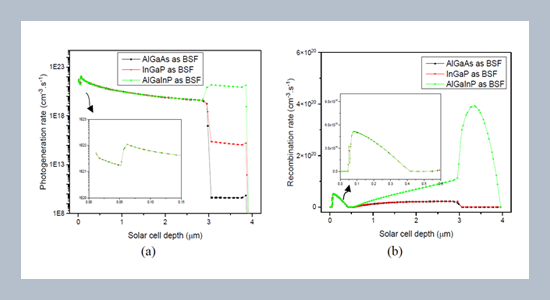
This study aims to analyze the impact of varying the front surface field (FSF) and back surface field (BSF) materials using Al0.8Ga0.2As, (Al0.7Ga0.3)0.5In0.5P, and In0.49Ga0.51P in pairs on single-junction GaAs solar cells performance with the aid of the SILVACO simulator. The solar cells with different FSF and BSF material sets are compared based on the photogeneration, recombination, and energy band structure. The results show that the initial cell without FSF and BSF gives an efficiency of 11.42%. When AlGaAs is used as the FSF layer the efficiency is significantly enhanced to 25.65%, 25.72%, and 30.16% as AlGaAs, InGaP, and AlGaInP are used for the BSF layer, respectively. When InGaP is utilized as the FSF layer, the efficiency also increases to 24.05%, 24.12%, and 27.94% as AlGaAs, InGaP, and AlGaInP are served as the BSF layer, respectively. The efficiency enhancement when AlGaAs and InGaP are used as the FSF is correlated to their high energy bandgap that enhances the photogeneration rate and smoothens the flow of photogenerated electrons toward the back contact. The extreme performance of the cells with AlGaInP BSF is attributed to the high potential barrier for the valance band between the base and BSF layer, which enhances the ability to confine the photogenerated holes in the solar cell and smoothen their flow toward the front contact. While using AlGaInP as the FSF layer, the cells' efficiency is degraded to about 6% regardless of the BSF material, which is due to the high potential barrier height for the conduction band between FSF and emitter and the low potential step between the emitter and base leading to a higher recombination rate for photogenerated electrons within the emitter. Based on this study, the best FSF and BSF materials set to obtain an optimum GaAs solar cell performance are AlGaAs and AlGaInP, respectively.


Keywords: Energy band diagram, GaAs solar cell, Photogeneration, Recombination, SILVACO


Share this article with your colleagues


REFERENCES


  1. Abu-Shamleh, A., Alzubi, H., Alajlouni, A. 2021. Optimization of antireflective coatings with nanostructured TiO2 for GaAs solar cells. Photonics and Nanostructures - Fundamentals and Applications, 43, 100862.

  2. Aissat, A., Benyettou, F., Vilcot, J.P. 2017. Electrical and optical properties of InSb/GaAs QDSC for photovoltaic. International Journal of Hydrogen Energy, 42, 19518–19524.

  3. Ansari, Z.A., Singh, T.J., Islam, S.M., Singh, S., Mahala, P., Khan, A., Singh, K.J. 2019. Photovoltaic solar cells based on graphene/gallium arsenide Schottky junction, Optik, 182, 500–506.

  4. Arzbin, H.R., Ghadimi, A., 2019. Improving the performance of a multi-junction solar cell by optimizing BSF, base and emitter layers. Materials Science and Engineering: B, 243, 108–114.

  5. Attari, K., Amhaimar, L., El yaakoubi, A., Asselman, A., Bassou, M. 2017. The Design and Optimization of GaAs Single Solar Cells Using the Genetic Algorithm and Silvaco ATLAS. International Journal of Photoenergy, 2017, 8269358.

  6. Bourbaba, H., Kadri, S., Djermane, K., 2019. Optimization of the performance of GaAs solar cells: Effect of the window layer. Journal of Ovonic Research, 15, 151–156.

  7. Devendra, K.C., Wagle, R., Shrivastava A., Parajuli, D. 2020. InGaP window layer for Gallium Arsenide (GaAs) based Solar Cell using PC1D simulation, Journal of Advanced Research in Dynamical and Control Systems, 12, 2878–2885.

  8. Gamel, M., Jern, K.P., Rashid, E., Jing, L.H., Yao L. K., Wong, B. 2019. Effect of front-surface-field and back-surface-field on the performance of GaAs based-photovoltaic cell. IEEE International Conference on Sensors and Nanotechnology, Penang, Malaysia,1–4.

  9. Islam, M.A., Sulaiman, Y., Amin, N. 2011. A comparative study of BSF layers for ultra-thin CdS:o/CdTe solar cells. Chalcogenide Letters, 8, 65–75.

  10. Kamdem, C.F. Ngoupo, A.T. Konan, F.K. Nkuissi, H.J.T. Hartiti B., Ndjaka, J. 2019. Study of the role of window layer Al0.8Ga0.2As on GaAs-based solar cells performance. Indian Journal of Science and Technology 12, 37, 1–9.

  11. Palacios, C., Guerra, N., Guevara, M., Lopez, M.J. 2018. TCAD 2D numerical simulations for increasing efficiency of AlGaAs – GaAs solar cells. Revista de I+D Tecnológico, 14, 96–107.

  12. Saif, A.A. 2023. High-Efficiency homojunction GaAs solar cell using InGaP as FSF and AlGaInP as BSF. Results in Optics, 12, 100454.

  13. Saif, A.A., Albishri, M., Mindil, A., Qaed, M. 2023. Superior efficiency for homojunction GaAs solar cell. Journal of Ovonic Research, 19, 1–14.

  14. Singh, B., Roshi, Gupta, V. 2022. Impact of different parameters on the performance of GaAs solar cell using PC1D simulation. Materials Today: Proceedings, 62, 6407–6411.

  15. Singh, G., Verma, S.S. 2018. Enhanced efficiency of thin film GaAs solar cells with plasmonic metal nanoparticles. Energy Sources, Part A: Recovery, Utilization, and Environmental Effects, 40, 155–162.

  16. Xu, H., Toprasertpong, K., Delamarre, A., Sodabanlu, H., Watanabe, K., Nakano, Y., Sugiyama, M. 2017. Effect of low-V/III-ratio metalorganic vapor-phase epitaxy on GaAs solar cells. Japanese Journal of Applied Physics, 56, 8S2, 08MC06.

  17. Zhao, Y., Sun, Y., He, Y., Yu, S., Dong, J. 2016. Design and fabrication of six-volt vertically stacked GaAs photovoltaic power converter. Scientific Reports, 6, 38044. 


ARTICLE INFORMATION


Received: 2024-05-12
Revised: 2024-05-30
Accepted: 2024-06-16
Available Online: 2025-08-12


Cite this article:

Ala’eddin A. Saif. 2025. Comparative analysis of GaAs solar cells performance using different FSF and BSF material sets. International Journal of Applied Science and Engineering, 22, 2024169. https://doi.org/10.6703/IJASE.202509_22(3).001

  Copyright The Author(s). This is an open access article distributed under the terms of the Creative Commons Attribution License (CC BY 4.0), which permits unrestricted use, distribution, and reproduction in any medium, provided the original author and source are cited.