Cholatorn Buaroy 1, Karnjana Detchomphoo 1, Napassakorn Pasriwong 1, Lalitwadee Thanee 1, Sasithorn Kongruang 1*

1 Department of Biotechnology, Faculty of Applied Science, King Mongkut’s University of Technology North Bangkok, Bangkok, Thailand


Download Citation: |
Download PDF


ABSTRACT


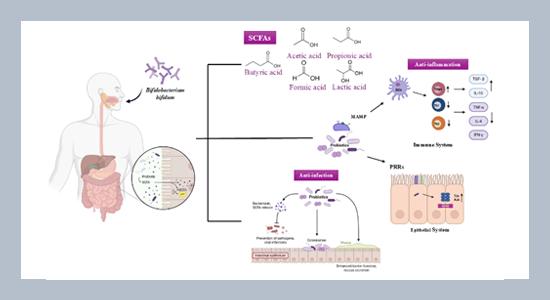
Agitation rate is a critical parameter influencing microbial physiology, metabolite synthesis, and overall fermentation efficiency. This study investigated the effect of agitation rate on biomass growth, lactic acid production, and short-chain fatty acid (SCFAs) synthesis by Bifidobacterium bifidum TISTR 2129 in a stirred-tank bioreactor. Batch fermentations were conducted at agitation rates of 100, 300, and 500 rpm over 168 h using MRS broth under controlled microaerophilic conditions. The findings indicated that increased agitation significantly enhanced cell growth and lactic acid production. The maximum biomass concentration (5.8 g/L) and lactic acid yield (9.0 g/L) were achieved at 500 rpm, indicating enhanced substrate accessibility and activity by bacteria. SCFAs analysis indicated that the most varied and abundant metabolite profile was observed at 300 rpm, with lactic acid (2711.73 mg/L), acetic acid (618.77 mg/L), propionic acid (141.70 mg/L), and butyric acid (710.16 mg/L) identified. High agitation promoted fast biomass production, whereas moderate agitation (300 rpm) optimized lactic acid by ~52-fold compared to 100 rpm and by > 300-fold compared to 500 rpm. Based on the kinetic parameters presented for B. bifidum at different agitation rates (100, 300, and 500 rpm), the results of the fitted models (Monod, Logistic, and Gompertz) reveal several important insights into the microbial growth behaviour under varying oxygen transfer conditions. This study offers valuable information for the development of probiotic fermentation processes and facilitates the advancement of functional foods and pharmaceutical goods abundant in bioactive components.


Keywords: Bifidobacterium bifidum TISTR 2129, Agitation rate, Short-chain fatty acid, Monod model, Logistic model, Gompertz model, Bioreactor.


Share this article with your colleagues


REFERENCES


  1. Baral, K.C., Bajracharya, R., Lee, S.H., Han, H.-K. 2021. Advancements in the pharmaceutical applications of probiotics: dosage forms and formulation technology. International Journal of Nanomedicine, 16, 7535–7556.

  2. Chen, J., Chen, X., Ho, C.L. 2021. Recent development of probiotic Bifidobacteria for treating human diseases. Frontiers in Bioengineering and Biotechnology, 9, 770248.

  3. De Bruyn, F., Smith, A., Jones, L., Wang, Y. 2024. Combining Bifidobacterium longum subsp. infantis and human milk oligosaccharides synergistically increases short chain fatty acid production ex vivo. Communications Biology, 7, 943.

  4. Devika, N.T., Raman, K. 2019. Deciphering the metabolic capabilities of Bifidobacteria using genome-scale metabolic models. Scientific Reports, 9, 18222.

  5. Din, A.U., Hassan, A., Zhu, Y., Zhang, K., Wang, Y., Li, T., Wang, Y., Wang, G. 2020. Inhibitory effect of Bifidobacterium bifidum ATCC 29521 on colitis and its mechanism. The Journal of Nutritional Biochemistry, 79, 108353.

  6. Fortune Business Insights, 2024. Probiotics market size, share trends analysis report, 2024–2032.Retrieved June 20, 2025, from https://www.fortunebusinessinsights. com/industry-reports/probiotics-market-100083

  7. Hill, C., Guarner, F., Reid, G., Gibson, G.R., Merenstein, D.J., Pot, B., Morelli, L., Canani, R.B., Flint, H.J., Salminen, S., Calder, P.C., Sanders, M.E. 2014. The International Scientific Association for Probiotics and Prebiotics consensus statement on the scope and appropriate use of the term probiotic. Nature Reviews Gastroenterology & Hepatology, 11, 506–514.

  8. Hossain, M.I., Sadekuzzaman, M., Ha, S.-D. 2017. Probiotics as potential alternative biocontrol agents in the agriculture and food industries: A review. Food Research International, 100, 63–73.

  9. Latif, A., Shehzad, A., Niazi, S., Zahid, A., Ashraf, W., Iqbal, M.W., Rehman, A., Riaz, T., Aadil, R.M., Khan, I.M., Özogul, F., Rocha, J.M., Esatbeyoglu, T., Korma, S.A. 2023. Probiotics: mechanism of action, health benefits and their application in food industries. Frontiers in Microbiology, 14, 1216674.

  10. Lee, N.K., Jang, H.J., Paik, H.D., 2024. Non-lactic acid bacteria probiotics isolated from intestine or various circumstances. Food Science and Biotechnology, 33(9), 1997–2007.

  11. Macfarlane, S., Macfarlane, G.T. 2003. Regulation of short-chain fatty acid production. Proceedings of the Nutrition Society, 62, 67–72.

  12. McFarland, L.V. 2021. Efficacy of single-strain probiotics versus multi-strain mixtures: Systematic review of strain and disease specificity. Digestive Diseases and Sciences, 66, 694–704.

  13. Mestre, A., Sathiya Narayanan, R., Rivas, D., John, J., Abdulqader, M.A., Khanna, T., Chakinala, R.C., Gupta, S. 2022. Role of probiotics in the management of Helicobacter pylori. Cureus, 14, e26463.

  14. Miller, G.L. 1959. Use of dinitrosalicylic acid reagent for determination of reducing sugar. Analytical Chemistry, 31, 426–428.

  15. Segui-Perez, C., Huang, L.Z.X., Paganelli, F.L., Lievens, E., Strijbis, K. 2025. Probiotic Bifidobacterium bifidum strains desialylate MUC13 and increase intestinal epithelial barrier function. Scientific Reports, 15, 1.

  16. Sun, S., Luo, L., Liang, W., Yin, Q., Guo, J., Rush, A.M., Lv, Z., Liang, Q., Fischbach, M.A., Sonnenburg, J.L., Dodd, D., Davis, M.M., Wang, F. 2020. Bifidobacterium alters the gut microbiota and modulates the functional metabolism of T regulatory cells in the context of immune checkpoint blockade. Proceedings of the National Academy of Sciences, 117, 27509–27515.

  17. Tsikliras, A.C., Froese, R. 2019. Maximum sustainable yield. Encyclopedia of Ecology, 108–115.

  18. Usta-Gorgun, B., Yilmaz-Ersan, L. 2020. Short-chain fatty acids production by Bifidobacterium species in the presence of salep. Electronic Journal of Biotechnology, 47, 29–35.

  19. Valle-Vargas, M.F., Rojas-Muñoz, Y.V., Ruiz-Pardo, R.Y., Villamil-Díaz, L., Quintanilla-Carvajal, M.X. 2025. Improving the survival under gastric conditions of a potential multistrain probiotic produced in co-culture. AMB Express, 15, 20.

  20. Vitetta, L., Oldfield, D., Sali, A. 2024. Inflammatory bowel diseases and the efficacy of probiotics as functional foods. Frontiers in Bioscience (Elite Edition), 16, 13.

  21. Weng, Y.-J., Zhang, L., Chen, H., Li, X., Zhao, M. 2021. Effects of pretreatment with Bifidobacterium bifidum using 16S ribosomal RNA gene sequencing in a mouse model of acute colitis induced by dextran sulfate sodium. Medical Science Monitor, 27.

  22. Xiao, J., Zhang, J., Wang, X., Li, M., Liu, Y. 2024. The causal relationship between immune cell-mediated gut microbiota and ulcerative colitis: a bidirectional two-sample, mediation Mendelian randomization analysis. Frontiers in Nutrition, 11, 1433545.

  23. Xiao, M., Zhang, C., Duan, H., Narbad, A., Zhao, J., Chen, W., Zhai, Q., Yu, L., Tian, F. 2024. Cross feeding of Bifidobacteria promotes intestinal homeostasis: a lifelong perspective on the host health. npj Biofilms and Microbiomes, 10, 47.

  24. Zhou, P., Chen, C., Patil, S., Dong, S. 2024. Unveiling the therapeutic symphony of probiotics, prebiotics, and postbiotics in gut-immune harmony. Frontiers in Nutrition, 11, 1355542.


ARTICLE INFORMATION


Received: 2025-06-24
Revised: 2025-08-16
Accepted: 2025-09-01
Available Online: 2025-09-30


Cite this article:

Buaroy, C., Detchomphoo, K., Pasriwong, N., Thanee, L., Kongruang, S. 2025. Effect of agitation rate for enhanced growth, metabolite production and kinetic modelling of Bifidobacterium bifidum fermentation. International Journal of Applied Science and Engineering, 22, 2025162. https://doi.org/10.6703/IJASE.202512_22(4).001

  Copyright The Author(s). This is an open access article distributed under the terms of the Creative Commons Attribution License (CC BY 4.0), which permits unrestricted use, distribution, and reproduction in any medium, provided the original author and source are cited.