
International Journal of Applied Science and Engineering
Published by Chaoyang University of Technology

Sittichai Charonerat 1, Thanatep Phatungthane 2, Chuthong Summatta 1*

1 Industrial Technology, Nakhon Phanom University, Nakhon Phanom 48000, Thailand
2 Division of Science, Faculty of Education, Nakhon Phanom University, Nakhon Phanom, 48000, Thailand


Download Citation: |
Download PDF


ABSTRACT


This study aims to optimize Friction Stir Welding (FSW) parameters to improve the mechanical properties of AA5083-AA6063 aluminum alloy joints, which are crucial for applications requiring high strength and durability. A Taguchi L9 orthogonal array experimental design was employed to systematically vary three key parameters: rotation speed, travel speed, and tool-pin taper angle, with the objective of maximizing tensile
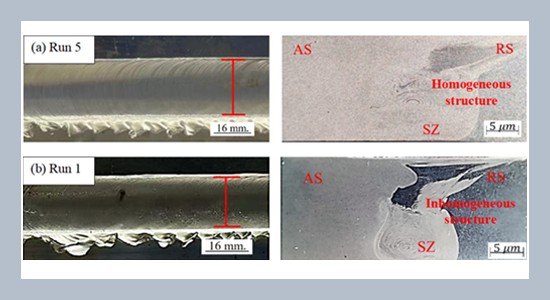
strength and hardness. The results demonstrated that a moderate rotation speed combined with a larger tool-pin taper angle produced optimal outcomes, achieving a tensile strength of 215.40 MPa and a hardness of 90.69 HV. Statistical analyses using signal-to-noise ratios and Analysis of Variance (ANOVA) identified rotation speed as the most influential factor affecting both tensile strength and hardness, followed by tool-pin taper angle, while travel speed had a minimal impact. Microscopic examinations revealed that the optimized settings yielded defect-free welds with ductile fracture patterns. These findings underscore the critical importance of precise FSW parameter selection in enhancing weld quality and contribute valuable insights for advanced manufacturing applications in industries requiring robust aluminum alloy joints.


Keywords: FSW, Dissimilar Aluminum alloys, Mechanical properties, Taguchi approach


Share this article with your colleagues


REFERENCES


  1.  Abdulhasan, A., Challoob, S.H., Abdulrehman, M., 2020. Studying the mechanical and numerical properties of friction stir welding (FSW) for 6005 aluminum alloys. IOP Conference Series: Materials Science and Engineering, 870, 012141.

  2. Al-Sabur, R., 2021. Tensile strength prediction of aluminium alloys welded by FSW using response surface methodology–Comparative review. Materials Today: Proceedings, 47, 1001–1007.

  3. Arun, M., Muthukumaran, M., Balasubramanian, S., 2021. Tribological characterization of friction stir welded dissimilar aluminum alloy AA6061–AA5083 reinforced with CeO₂ and La₂O₃ nanoparticles. Industrial Lubrication and Tribology, 73, 431–439.

  4. Balamurugan, A., Bhuvaneswari, M., Suresh, K., Sudha, M., 2023. Investigation on the mechanical properties of FSWed AA6063–T351 aluminum alloy joints. Materials Today: Proceedings, 72, 553–559.

  5. Dharani Kumar, S., Sendhil Kumar, S., 2019. Investigation of mechanical behavior of friction stir welded joints of AA6063 with AA5083 aluminum alloys. Manufacturing and Materials Engineering, 23, 59–67.

  6. Elatharasan, G., Manikandan, R., Karthikeyan, G., 2020. Multi-response optimization of process parameters in friction stir welding of dissimilar aluminum alloys by Grey relation analysis (AA 6061-T6 & AA5083-H111). Materials Today: Proceedings, 33, 1720–1724.

  7. Elnabi, M.M.A., Elshalakany, A.B., Abdel-Mottaleb, M., Osman, T., Mokadem, A., 2019. Influence of friction stir welding parameters on metallurgical and mechanical properties of dissimilar AA5454–AA7075 aluminum alloys. Journal of Materials Research and Technology, 8, 2364–2376.

  8. Kumar, P.S., Chander, M., 2020. Effect of tool pin geometry on FSW dissimilar aluminum alloys - (AA5083 & AA6061). Materials Today: Proceedings, 39, 472–477.

  9. Lewise, K.A.S., Dhas, J.E.R., Pandiyarajan, R., Sabarish, S., 2023. Metallurgical and mechanical investigation on FSSWed dissimilar aluminum alloy. Journal of Advanced Joining Processes, 4, 100010.

  10. Nopriantoko, R., 2023. Energy absorption and toughness analysis on FSW butt joint of AA 5052 and AA 5083. Politeknik Journal of Mechanical Engineering, 21, 4107.

  11. Okubo, M., Kon, T., Abe, N., 2007. Mechanical properties of aluminum-based dissimilar alloy joints by power beams, arc and FSW processes. Journal of High Temperature Society, 33(4), 208–216.

  12. Patel, V.V., Li, W., Wang, G., Wang, F., Vairis, A., Niu, P., 2019. Friction Stir Welding of dissimilar aluminum alloy combinations: State-of-the-Art. Metals, 9(3), 270.

  13. Serier, M., Berrahou, M., Tabti, A., Bendaoudi, S., 2019. Effect of FSW welding parameters on the tensile strength of aluminum alloys. Applied Mechanics and Materials, 39, 41–48.

  14. Umanath, K., Palanikumar, K., Sankaradass, V., Uma, K., 2021. Optimizations of friction stir welding process parameters of AA6063 Aluminium alloy by Taguchi technique. Materials Today: Proceedings, 46, 2006–2010.


ARTICLE INFORMATION


Received: 2024-11-21
Revised: 2025-04-18
Accepted: 2025-09-01
Available Online: 2025-09-30


Cite this article:

Charonerat, S., Phatungthane, T., Summatta, C. 2025. Optimizing friction stir welding parameters for enhanced mechanical properties of dissimilar aluminum alloys AA5083 and AA6063: A Taguchi approach. International Journal of Applied Science and Engineering, 22, 2024387. https://doi.org/10.6703/IJASE.202509_22(3).006

  Copyright The Author(s). This is an open access article distributed under the terms of the Creative Commons Attribution License (CC BY 4.0), which permits unrestricted use, distribution, and reproduction in any medium, provided the original author and source are cited.